“there’s a sort of worth to the man beyond his class”
 In asking the
question of class of both Felix and Edith, I find myself drawing lines in the
proverbial class status sand. If trying to give a hard and fast answer to what
class Felix Holt is according to evidence from the book, I would quickly
conclude that he is of the working class. The reader is given to understand
that his father was in the trade of quack doctoring in selling his miracle and prayed
over (and therefore not dishonest) tonics that helped cure people high and low
(Ch.3). The sales from this tonic helped send Felix away for an education.
However, it is clear that it was not the education that his family had quite
intended. In Ch.4, we learn that Felix gave up his apprenticeship, which we can
assume was to an apothecary of sorts, and used the money to pursue an education
in Glasgow. While his mother’s hope was that this education would lead him to
hopefully become a doctor since he would “have more schooling than his father,”
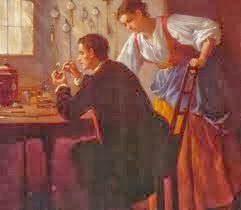
he chose to work with his hands and pick up an honest trade in watchmaking and
repairing in addition to using his education to teach children of his own class (Ch.22).
In Edith’s case, the
mystery of class is more confused and the web harder to pull apart. Being
raised by her clerical step-father, Rufus Lyon, the reader would assume that
Edith is the same class. When it comes to the class of pastors and their
families, I find it safe to say they are middle-class because, although they
have no land, they are educated, do not work in a ‘laboring’ trade, and are
looked up to by the working masses. In Mr. Lyon’s case though, he is a
Dissenting preacher, and therefore not appointed by the Church of England. In
that case, his class might be questionable. Still based on education and place
in the community, a bet on the middle-class seems safe. Edith, herself, is well
educated since she was sent off to a, importantly Protestant (wouldn’t want any
French radicalism to accidentally sink in), boarding school in France. However,
it appears that both Edith’s mother and father were from better established
families. Edith’s deceased father, Maurice Christian Bycliff, had a claim at
Harold’s title that he may, from the maniacal work of Jermyn, have been cheated
out of. This of course means that Edith would have been the child of landed
gentry. In this case, no longer would would she then be considered middle-class, but
upper-class.
However, I do find that
these lines of class are purposefully drawn in the sand by brilliant Eliot.
Class is set up to be questioned all throughout. While Felix is set up in
detail to be a man of the working class, his political ideas, his speech, his
behavior (controlled drinking) and his education (although decidedly not his
manner of dress) marks him out as middle-class. In addition, he is looked up to
by working class men, Edith, and conceived as an equal by Mr. Lyon. The winds
must be moving his line. In Edith’s case, while she is set in the middle-class
by being raised by her father, her movements, the lines of her neck, her dress,
and her gold accessories set her to be part of at least a better off
middle-class if not gentry.
What I find interesting
in all of these is that class is, whether known or unknown to the party itself,
hidden, almost costumed. Mannerisms and behavior are portrayed as the best
indicator of status. In thinking of Henry Scaddon (a.k.a Maurice Christian) and
Jermyn, their places of class are supposedly well marked by their work. Scaddon
is a kind of servant to the Debarrys; Jermyn is a ‘successful’ lawyer to a
landed family. While Scaddon actually comes from a higher class and Jermyn is
marked off as middle-class by his trade in being a lawyer, they are also marked
out by their deceit, their scummyness (It’s now a word, and they made it so). In
this way, the mannerisms and behaviors mark out class beyond status to note the
sheep in wolves clothing and the worth of a man (or woman!) beyond his (or
her!) class.
